
Orlando Resident Lookup Sources
No single public roll proves where an Orlando resident lives. The strongest match combines two dated sources that describe the person in different roles. The Orange County Property Appraiser can link an owner to a parcel and mailing address. Orange Elections can confirm a voter record when the required identity details are known. Court dockets show party roles and case outcomes, while marriage and death records establish family events. Business and license files confirm an affiliation, not a home.
| Record | What It Confirms | Where to Search | Access |
|---|---|---|---|
| Property roll | Owner, parcel, mailing address, homestead flag | Orange County Property Appraiser | Free online |
| Voter record | Registration address, status, party and precinct | Orange County Elections | Status check or records request |
| Court docket | Party role, case type, filing date and disposition | Orange Clerk my eClerk | Free index; copies vary |
| Marriage or death | Dated event and named relationships | Florida Health or Orange Clerk | Public rules vary by record |
| Business or license | Officer, agent, licensee and filing status | Sunbiz, DBPR and other state boards | Free indexes |
Start with the property roll when an address or owner name is known. Begin with my eClerk when a case number or court role is the key. A voter status check requires first name, last name, and date of birth, so it is a confirmation tool rather than a way to browse strangers. For family research, use marriage, death, probate, and deed evidence together. Keep the date and role from every result. A registered agent, parcel owner, or litigant should not be labeled a current occupant without separate proof.
Check Orlando Court Name Matches
The Orange County Clerk my eClerk search covers county and circuit matters in the Ninth Judicial Circuit. A party search requires first and last name. Case number, court division, filing dates, and date of birth may narrow certain searches. Results are capped at 500, so common names need a tighter date span or division. Most docket information reaches back to about 1990, and most online documents begin around 2009. Older files may require the clerk’s counter or a records request.
| Search field | How it helps |
|---|---|
| Last or business name | Runs the main party-name search; try spelling variants |
| First name | Separates many same-surname results |
| Court type or division | Limits civil, criminal, family, probate or traffic matters |
| Date range | Restricts filing or activity dates where offered |
| Case number | Opens a known clerk file directly |
A docket can show the case number, style, party roles, division, filing date, status, judge, event descriptions, and public document links. It proves that a filing occurred, not that an allegation was true. Read the disposition or judgment and confirm the party with another source. Sealed, adoption, juvenile, protected family, victim, and confidential exhibit material will not appear to the general public.
The Clerk Records office accepts a case number, party name, birth date, requested document, and years to search. Requests may be mailed or taken to 425 N. Orange Avenue, Suite 150. Mailed requests normally receive cost and delivery information in about ten business days. The captured clerk page lists $1 per page and $2 certification per document, but current charges should be checked before ordering.
The clerk’s records-request screen shows the fallback when an Orlando resident lookup reaches an archived or restricted online file.
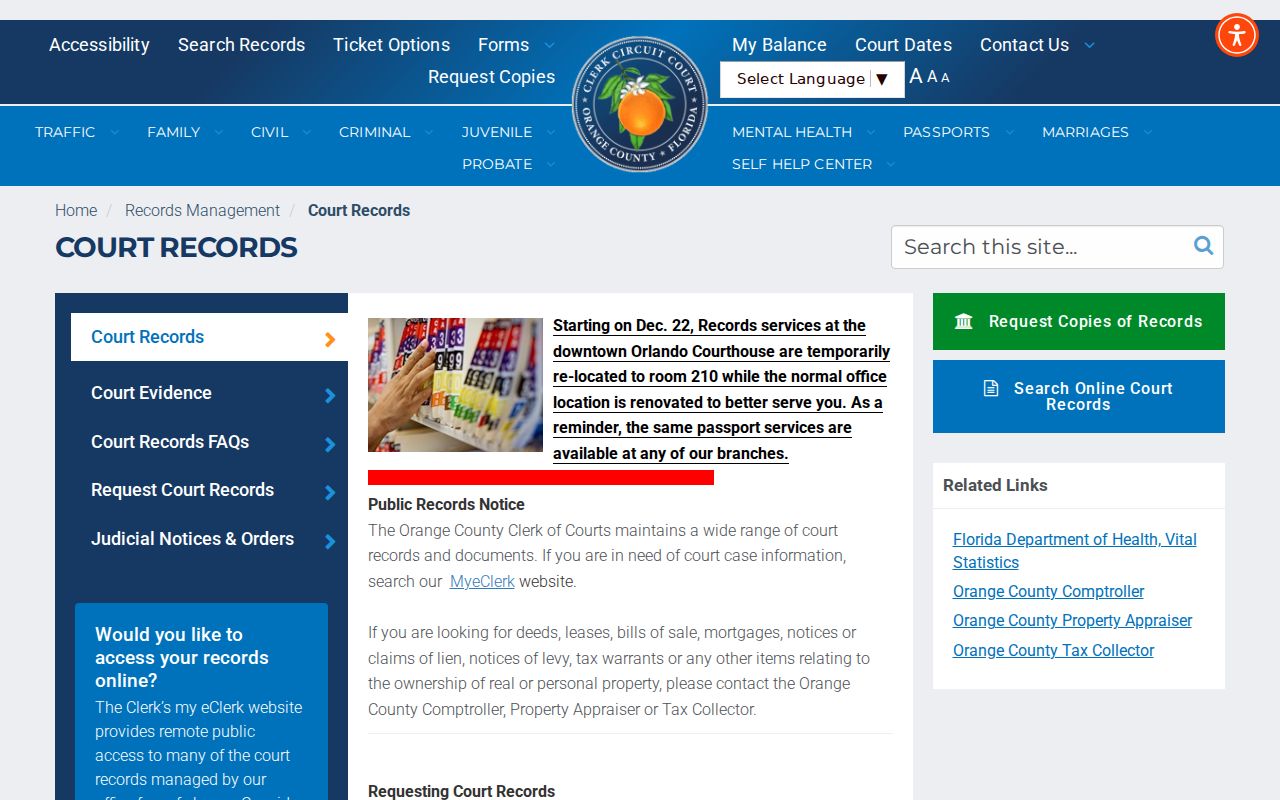
That request route is especially useful when an older docket appears in the index but its document image is not downloadable.
Separate Orlando Court Systems
Florida’s Appellate Case Information System, or ACIS, searches appellate cases, parties, oral arguments, documents, and publications. It is not a statewide trial-court index. Orlando trial matters remain with my eClerk, while federal matters in the Middle District of Florida use PACER. Mixing those systems is a common source of false dead ends.
The ACIS screen below is a useful reminder that appellate and local trial records answer different questions.
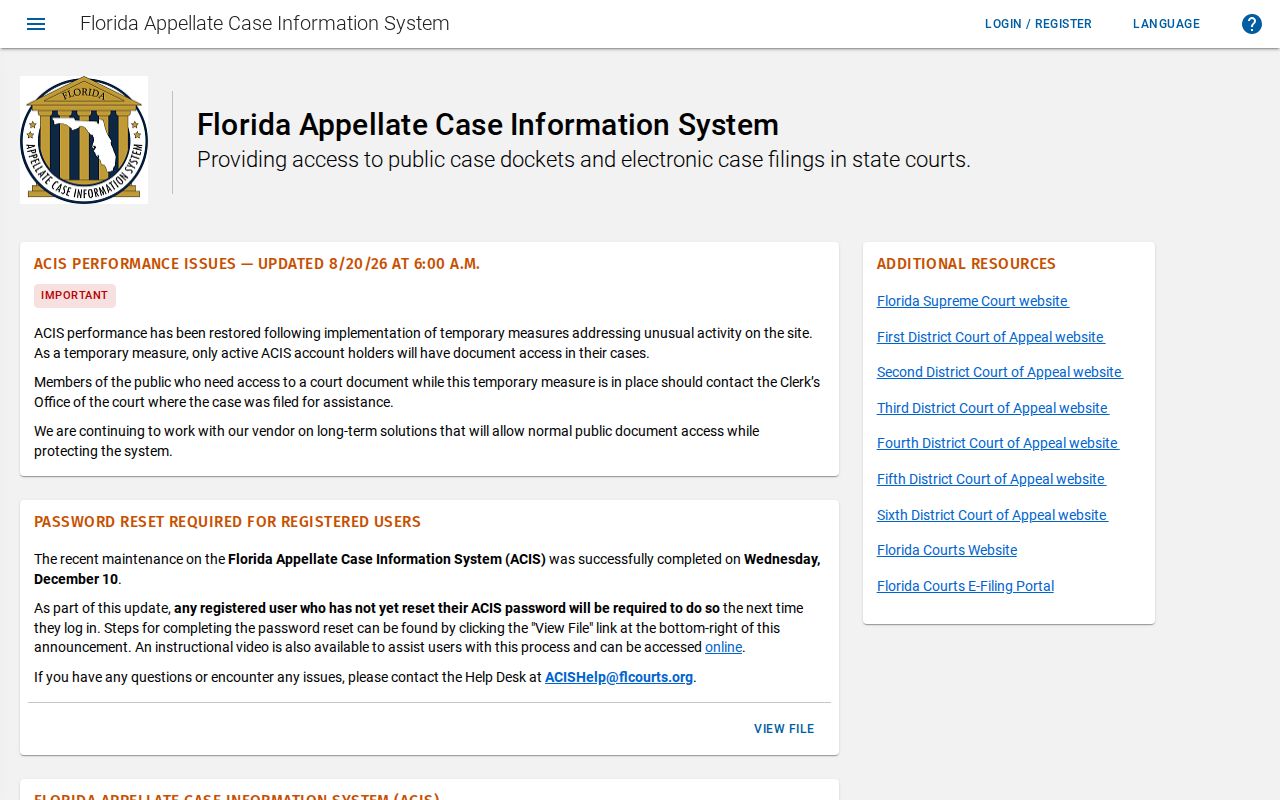
An ACIS party match should still be checked against the appellate case details and an independent Orlando address or affiliation.
The Fifth District Court of Appeal also explains its online public docket. Its public access page appears below.
The district page helps place an appellate result in the correct court rather than treating it as an Orange County trial filing.
Federal court records are searched through PACER by party name or case number. PACER generally charges ten cents per page, caps a document at three dollars, and waives quarterly bills of thirty dollars or less under its stated policy. The federal portal is shown here.
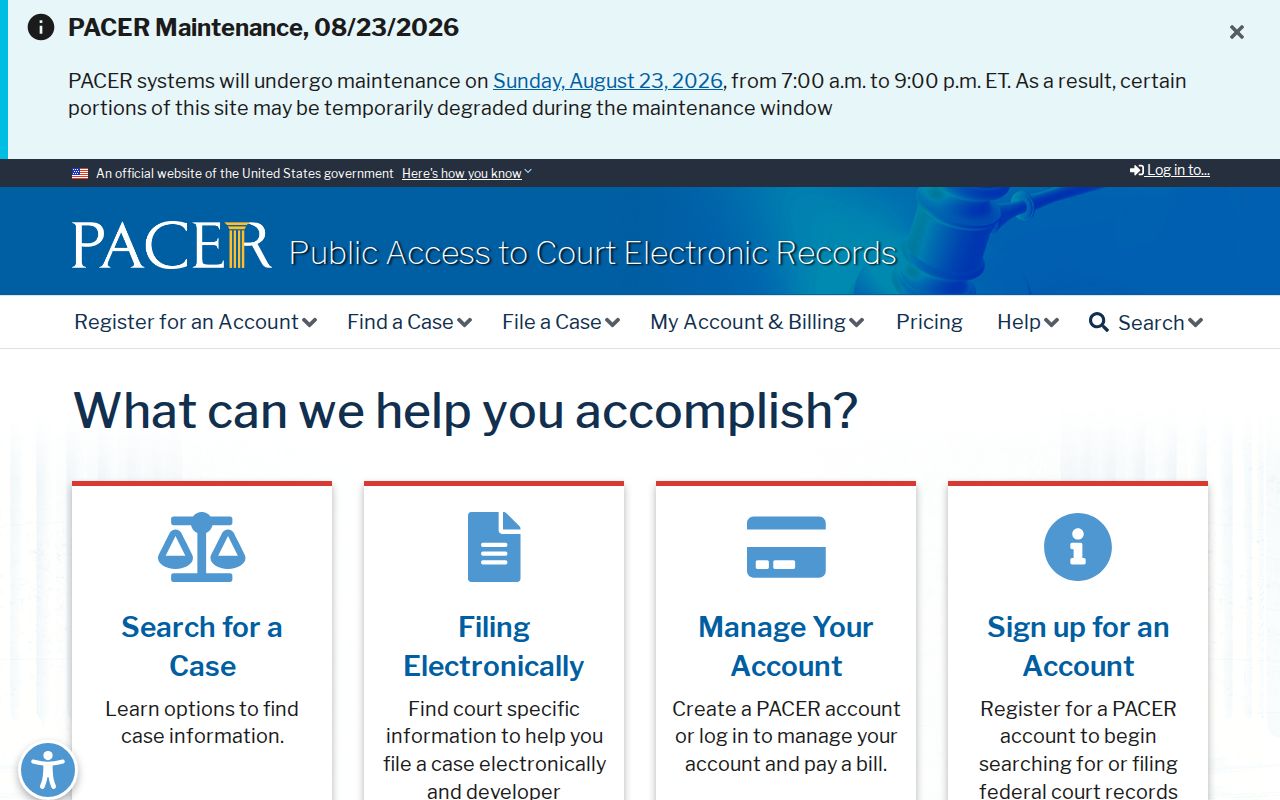
A federal name result is only a lead until the case facts, location, and identity details align.
Verify Orlando Resident Records
A sound resident lookup uses two independent anchors. Normalize maiden names, hyphenated names, middle initials, and common spelling variants before searching. Then compare dates and roles. The same parcel plus a matching probate detail is far stronger than two pages that copied the same business filing. An owner, licensee, officer, or court party may have no present connection to the mailing address shown.
- Search the OCPA owner roll or confirm a known voter record. Record the address type and the date of the source.
- Run my eClerk with the full name and likely variants. Narrow common names by division and date.
- Compare the docket role, parcel, deed, marriage, death, probate, or license detail. Require at least two matching facts.
- Order a certified copy from the custodian only when an official copy is needed. Do not treat a search screen as the record itself.
- Docket
- The dated list of filings and court events in a case.
- Index vs image
- An index points to a record; an image displays the filed document itself.
- Certified copy
- A custodian-issued copy bearing formal proof that it matches the official record.
Note: Inactive voter status may follow address-confirmation procedures and does not, by itself, prove that an Orlando resident moved.
Confirm Orlando Voter Information
The Florida voter status tool asks for first name, last name, and date of birth. Orange County’s route is available through the Supervisor of Elections. These are identity checks, not street-browse directories. Florida treats name, residence address, birth date, party, phone, and email as public voter data, but Social Security, driver-license, state-ID, registration-source, and protected-address details are withheld. A signature may be viewed but not copied.
Because the form requires a birth date, it should confirm a person already known rather than support broad name browsing. A full public voter file requires a records request and arrives with exempt information removed.
Orlando Vital Record Proof
Marriage and death evidence can separate two people with the same name. The Florida Bureau of Vital Statistics issues statewide certificates, while the Orange Clerk holds local marriage-license records and court files. Marriage certificates are public and require no ID. The state certificate is an abstract, so the clerk’s license, return, or application may provide the more direct local record.
Birth records demand more care. Florida births younger than 125 years are confidential. Eligible requesters include the adult registrant, a named parent, guardian, legal representative, or a person with a court order. The official Florida birth access page is shown below.
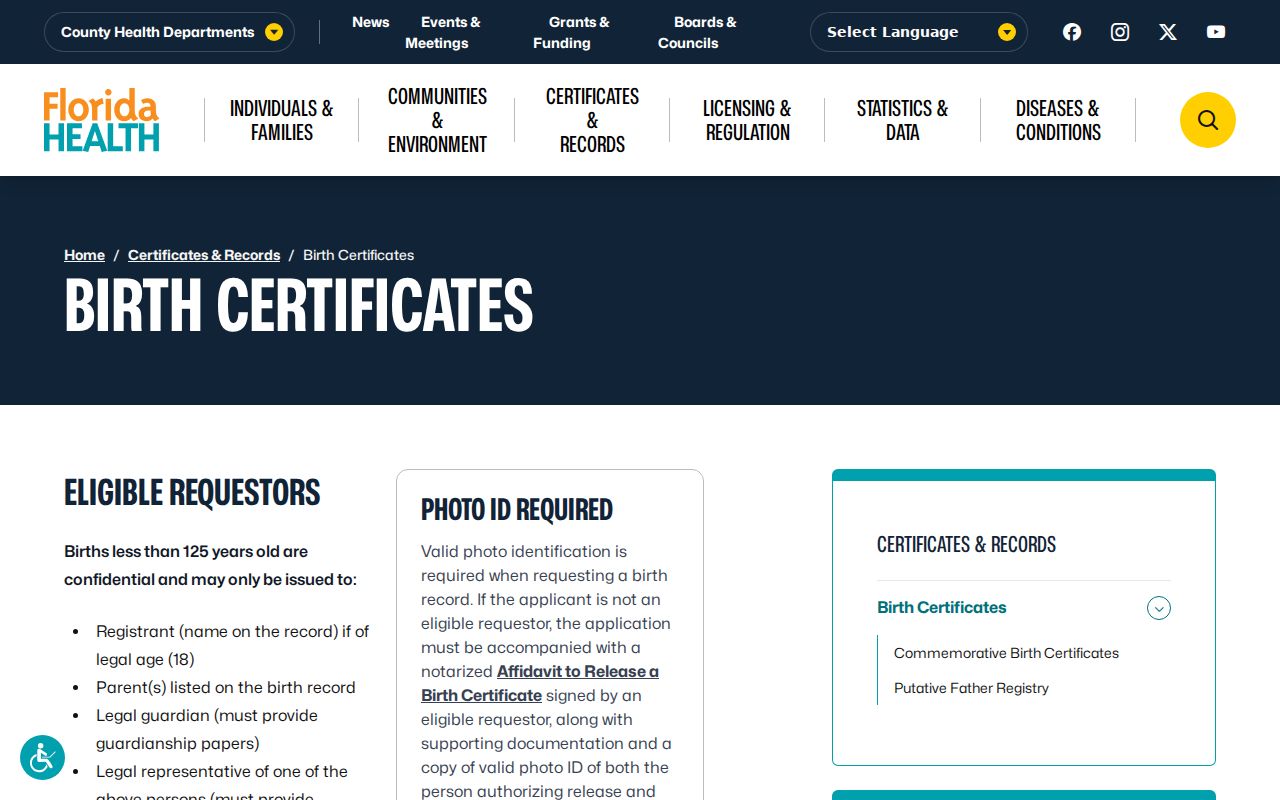
The eligibility rules explain why no open modern birth directory can complete an ordinary Orlando resident lookup.
The state forms hub provides official birth, death, marriage, and dissolution applications.
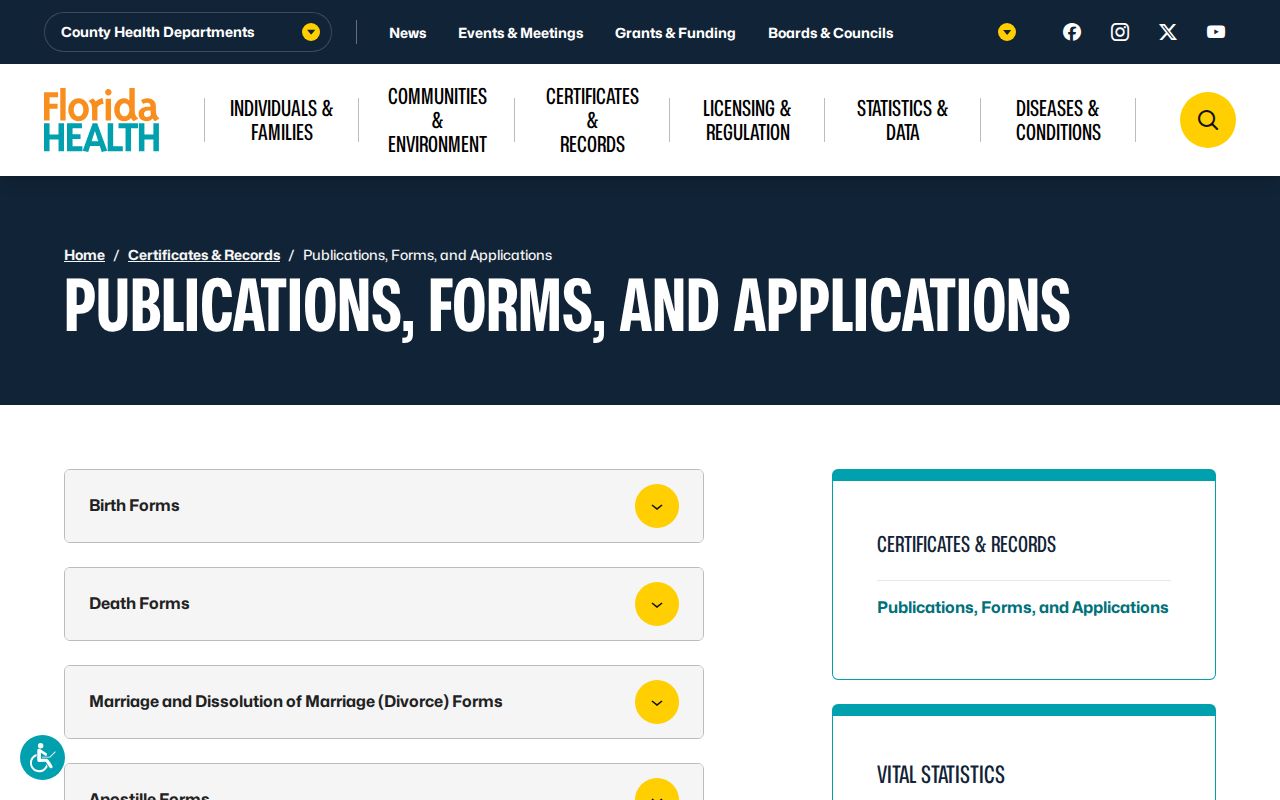
Use the form that matches the event and supply only the identity and eligibility proof it requests. Death certificates without cause are generally available, while cause remains confidential for 50 years except to eligible people.
Find Orlando Family Connections
Different family questions call for different official chains. To identify an heir, begin with the Orange probate docket, then read any public will or inventory, compare the death record, and follow later deeds signed by heirs. A person seeking a birth parent should use the Florida Adoption Reunion Registry, a consent-based state route, because adoption files are confidential. Former classmates may appear in OCLS or UCF yearbooks and historical directories before a modern record confirms the current identity.
When a resident lookup fails online, make a narrow request under the Florida Public Records Law. Name the custodian, record type, likely years, person or address, and preferred electronic format. Florida does not require a special form, a written request, or a statement of purpose. Ask for an estimate before extensive work. If an agency claims an exemption, it must cite the basis and explain it in writing when asked.
Confirm Orlando Filing Roles
Sunbiz can search corporations by entity, officer or agent, document number, ZIP, and street. DBPR and other boards search licenses by profession, name, business, and location. These sources are useful for checking a dated affiliation. They do not prove residence. A principal office, registered-agent address, firm address, or license contact must be described by the role printed in the filing.
Commercial people-finder data can be stale, merged, or copied from one source to another. A paid screen is not official proof. Confirm every useful lead at the public custodian, record its date, and correct an official error through that custodian’s challenge process.
Orlando Resident Lookup Limits
Public access has firm boundaries. Florida Safe at Home supplies a substitute mailing address to qualifying victims through trained application assistants. Separate exemptions can shield addresses of listed victims and occupational groups. Motor-vehicle personal data is restricted by federal law. Protected voter records, confidential vital certificates, sealed cases, utility data, and private household lists do not become open merely because another public record names the person.
Florida’s Digital Bill of Rights may give rights to access, correct, delete, obtain a portable copy, or opt out with a covered commercial controller, but its thresholds are narrow. It does not create a universal right to erase lawful government records. Use a service’s own privacy channel for commercial opt-outs, share only what is needed to verify identity, save the confirmation, and check again later.
Lawful use. An Orlando resident lookup is for lawful personal research. Public access never permits stalking, threats, harassment, or intimidation under Florida law.